
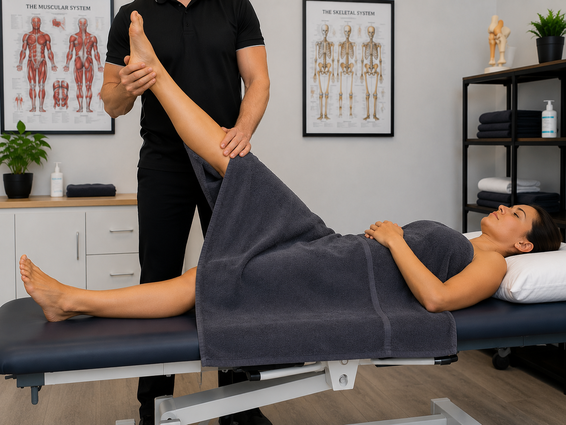
Muscle Energy Technique (MET) is a precise, patient-assisted manual therapy used by trained practitioners to improve musculoskeletal function. It involves the patient performing gentle, controlled muscle contractions against a practitioner’s resistance, followed by a stretch or repositioning phase. This active participation distinguishes MET from passive therapies and allows for highly targeted, adaptable treatment.
MET is based on neurophysiological principles such as post-isometric relaxation and reciprocal inhibition. The practitioner positions the affected joint or muscle at a specific barrier, then guides the patient through a low-force contraction (typically 10–30% effort) for several seconds. After relaxation, the tissue is taken to a new range, progressively improving mobility and reducing restriction.
Key characteristics:
-
Low-force, safe and controlled
-
Tailored to individual tolerance and condition
-
Combines assessment and treatment in one process
-
Can be applied to joints, muscles and fascia.
For relatively inactive or elderly patients, MET offers a gentle and safe method to:
-
Improve joint mobility and flexibility
-
Reduce stiffness and discomfort
-
Support balance and functional movement
-
Minimize risk due to its low-load, controlled nature
It is particularly valuable where more forceful manual techniques or exercise interventions may be inappropriate.
In everyday clinical practice, MET is widely used to:
-
Restore normal movement patterns
-
Alleviate acute and chronic musculoskeletal pain
-
Enhance posture and alignment
-
Support recovery from injury or surgery
Because it actively engages the patient, it can also improve body awareness and neuromuscular control.
For physically active clients and elite athletes, MET provides:
-
Increased range of motion without compromising stability
-
Reduction of muscle tightness and imbalance
-
Enhanced recovery and reduced injury risk
-
Optimization of biomechanical efficiency
Its precision makes it particularly useful in high-performance settings where small improvements in mobility and coordination can significantly impact performance.